
This blog is dedicated to the practice of using technical architecture to “de-risk” technology programmes (and save money). The NHS have recently awarded a £330 million 7-year contract to a consortium using Palantir software for a data warehouse / reporting solution, known as the Federated Data Platform (FDP).
There are challenges with a programme of this type, specifically:
- Risk – success is dependent on a single software product, which if it can’t achieve the core aims, will result in cost overruns and scope limitation. I highlighted the challenge when a programme is reliant on a single component in a previous blog post. How do we know the results it is producing are correct ?
- Cost – the project is hugely expensive for a project of this type – one of the most expensive projects ever procured within government IT.
- Offboarding issues – there will be challenges when re-procuring with a better / cheaper supplier in future without starting again after 7 years.
There is an excellent report on the procurement and challenges associated with the programme here:
The NHS Federated Data Platform and Palantir – Doctors Association UK June 2023
I can’t comment on the quality of the Palantir software as I have never used it or seen it in action. The procurement approach has been challenged by the Good Law Project, but I wanted to highlight how a Building Block Architecture approach can avoid programmes such as this arriving at such a high risk position.
As a bit of background, at a Government Department, I led a delivery project to develop a reporting system for complex citizen data requiring reporting on cohorts and multiple overlapping episodes. It was a similar scale of complexity as NHS data – and it was built for less that £2m – and was able to produce a wide range of statutory statistics. While the data volumes are greater for the NHS and assuming the data is more complex, I would have expected FDR to be built and operated for a much lower figure than £330 million.
The way data warehouse reporting is done is usually by creating a Dimensional Model – without going into any more detail, a Dimensional Model allows you to query and report on any combination of data items and, most importantly, is supported by a wide range of reporting tools off the shelf. (Tableau, Pentaho, Microsoft Power Builder, Oracle Business Intelligence, for instance.) So if you build a dimensional model, you can report on it using a variety of tools that the data modellers are familiar with and for which they may already have software licences. (Also, some reporting tools are better than others for different reporting requirements.) The approach of Building Block Architecture is to use standards and APIs to break down a complex system into smaller, lower risk components – and an “open” Dimensional Model would be a great place to start.
I believe that a user can only use Palantir tools to report on and extract data – and their software licences are expensive if deployed across the NHS. NHS Trusts requiring reports may also have to use Palantir experts (from PwC, Accenture etc.) to help with data extraction and reporting, as highlighted below:
“By technical design Palantir has explicitly
https://www.foxglove.org.uk/wp-content/uploads/2023/06/2023_06_05-FINAL-The-NHS-Federated-Data-Platform-and-Palantir.pdf
avoided creating a system that you can
easily extract data from or that works
well with other industry–standard data
analytics systems. Palantir’s system
pushes people to its own proprietary
systems; and switching costs will be very
high.”
The NHS have also shown that data sharing and reporting can be achieved for a fraction of the FDP contract (see below)
OneLondon, for example, already uses
https://www.foxglove.org.uk/wp-content/uploads/2023/06/2023_06_05-FINAL-The-NHS-Federated-Data-Platform-and-Palantir.pdf
a shared data environment for some 9
million Londoners. It recently awarded
a data management contract to Better for
just £3m for several years – that is, less
than 1% of the FDP’s tender price to serve
almost 20% of the same population.
What Foundry (Palantir) would add to this system, for many fold the expense, is far from clear.
If OneLondon developed something for 9 million Londoners for £3m, one could assume a price tag around £30million for a scaled up system, although economies of scale could result in an even lower total cost.
The Building Block Architecture approach is to break the requirement down into Building Blocks before procurement and have different components delivered by a number of suppliers using a series of short procurements (either using frameworks such as GCloud or Dynamic Purchasing frameworks.)
As a technical architect, I would have sketched out how this could be done – my preferred method would be to sit in one of the many coffee bars near Horseferry Road and draw the solution on a paper napkin. Having delivered something similar previously, it would take no more than an hour to work this out – the time it would take to drink a Americano !
I would double up some components where it it hard to check and test results – one of the challenges of data modelling is that it is hard to spot errors as the data models become complex. As a result, I would recommend building two dimensional models with two separate teams – a complete model and a cut down version that could check the results from the complete model. (This would avoid the Horizon problem.) It would also help keep the teams honest!
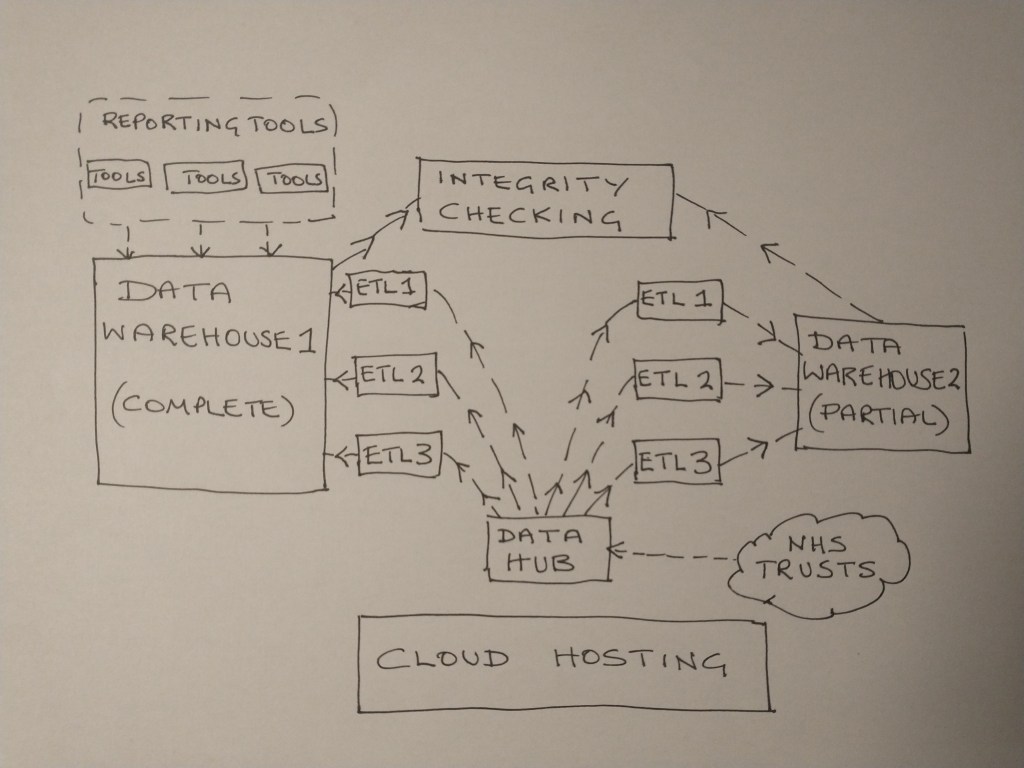
It would require eight simple procurements, which could be completed within a few months. (The requirements for each component would be at high level only at the procurement stage, and would use Agile methods to refine during delivery.)
These would be:
- Reporting tools (multiple suppliers from existing frameworks) – increasingly with Artificial Intelligence capabilities built in
- Cloud Hosting (from existing frameworks)
- Data Hub – to allow submission of data
- ETL processes to load data and build the model (x2) – two separate contracts and team – in practice there will be as many ETL processes as data sources
- Management of Data Warehouses
- Integrity Checking – including testing – to make sure both models produce the same results
- Overall Programme, Project and Supplier Management
The last procurement is required to put in place a delivery team to manage the various suppliers and the overall programme ( if there are not resources and skills in house). Their responsibilities would include:
- Technical Architecture and High Level Specifications – which needs to include defined APIs/interfaces – e.g. likely to be XML/JSON data feeds, SQL etc.
- Procurement Requirements
- Supplier selection
- Supplier Management
- User Liaison
If you break down the programme in this way, and you estimate based on these Building Blocks, you can quickly conclude that a programme similar to FDR could be delivered for a fraction of the cost of the FDM project (and with less risk) – using OneLondon figures you could be saving £300m – for the price of a cup of Horseferry Road Coffee.
It is also worth pointing out that the Palantir project is building a proprietary data model, which could not be migrated to another supplier without another huge expense at the end of the seven year contract, so a large chunk of the current contract will be wasted.
In my opinion, the next government should do all it can to cancel this contract as soon as possible and move to an open, “building block” approach.
DISCLAIMER:
I have no inside knowledge of the NHS FDR Programme – this article is based on what I have read in the news and some research into publicly available information on Palantir and its past projects and my background in similar projects. Of course, there may be many aspects of this project of which I am unaware, so my estimate of £300 million savings should be seen in this context but I believe the points I make illustrate the benefits of a different approach. While the suppliers may be doing a wonderful job, and the system may be fantastic, the secrecy surrounding the Programme, the Contract and the Software Product does not fill me and many others with confidence that what is being delivered is value for money.
References:
- https://www.computing.co.uk/news/4160079/nhs-england-palantir-contract-transparency
- https://goodlawproject.org/case/were-taking-legal-action-to-uncover-palantirs-blanked-out-contract/
- https://www.theguardian.com/commentisfree/2023/nov/28/the-guardian-view-on-the-nhs-and-palantir-the-case-for-this-data-deal-looks-weak
- https://bylinetimes.com/2022/06/30/how-the-tentacles-of-palantir-continue-to-encircle-the-nhs/
 Building Block Architecture
Leave a comment